
Soon after I purchased Blueberry Hill Farm I introduced myself to the neighbors. Every single one had the same request: “Don’t shoot the propane cannon.”
The farm is small (4.5 acres) and my neighbors are all close enough to hear and see just about every farm activity. They are overall quite tolerant of farm noise from customer traffic, material deliveries, chainsaws, and other power tools. Though noise from farm activities can be annoying they’re not harmful. The propane cannon on the other hand produces a sonic blast up to 130 decibels which is the threshold of pain for human hearing. It is a traditionally accepted tool for deterring birds from predating agricultural crops and was used often enough on the farm over the years to create a lot of anxiety and some bad relations.
The agricultural industry considers the propane cannon to be a humane bird deterrent because it scares but does not physically harm the birds. However, it is a wide broadcast method that does not target a single species. When used, all creatures in the nearby area—including humans, pets, wildlife, plants, bacteria, fungus…—are in its path. The blasts begin at dawn, end at dusk, and can take an unknown amount of time to successfully scare off an entire flock of birds. In the meantime, all creatures within the blast zone experience high levels of stress and sometimes physical pain.
Avoiding the use of the propane cannon sounded like a very fair request so I set out to find an alternative.
The method for excluding birds that appealed to me most was the installation of netting over the fields of bushes. Research into netting quickly revealed that it was far too expensive even for my small farm. Just the purchase of netting was outside of my budget, and it comes with annual labor costs of set up and take down.
Next best and least harmful was the discovery of “bird lasers“. Some clever person discovered a laser wavelength that birds visually perceive as a solid substance. When a laser with this wavelength approaches (most) birds get scared and fly away. This silent, harmless approach to scaring off birds sounded great until I found its price tag which was also well outside my budget.
I was chatting with a friend about all of this research and they shared that the nearby Alexandre Dairy had purchased some of the lasers a few years ago. I contacted the dairy and learned that not only were they no longer using the lasers but they were willing to loan me a couple to try out.
I then got in touch with the company that makes the lasers and requested assistance with installation. They helped me plan the best locations to install the lasers and agreed to send one of their team members to the farm to help with the final steps. One laser would be fairly easy to install on top of a 20 foot pole attached to the side of the barn. The other laser needed to be positioned at the center of the fields where it would need to run on solar power. Attempts to install a 20 foot pole for the solar laser proved challenging in a soggy field after months of Crescent City winter rain. In the end we were able to secure it with a concrete base.
Making the fields miserable for birds with the lasers is more effective at the time of year when birds are looking for a place to nest. If you can prevent birds from nesting in your field, you’re also preventing them from teaching their kids to forage in your field. It was late April by the time we were actually installation-ready so by then I was biting my nails quite a bit and nervously eyeing amorous birds nearby.
On April 26th, Servando from the Bird Control Group arrived with great confidence that we could get everything installed in one day. I had rented a boom lift for him to easily reach the tops of the poles and get the lasers hooked up and running. The boom lift worked a treat for the laser mounted on the barn. That laser was mounted and running in an hour.
The other laser… not so much. In the process of towing the boom lift towards the pole mounted in the field I managed to get both the boom lift and my truck stuck in the mud. Worse, the boom lift was so darn heavy it was actually sinking deeper the longer it took us to figure out how to pull it back out. We scrambled to find planks of wood to jam under the wheels and in the end it was Servando’s 4-wheel drive Subaru Outback that saved the day and he towed the boom back up to the dry parking lot.
Without the boom lift, the top of the pole in the field seemed impossible for us to reach. Leaning a ladder against it was out of the question because at 16 feet (4 feet was in the ground) it was too bendy. The sun was setting and we were both exhausted but Servando refused to be beaten. He set out for Home Depot and returned with boxes of scaffolding kits. They felt barely more trustworthy than erector sets I had played with in the 70s but it was the best option that we had available. The next morning it took us hours to create a stable and level foundation for the scaffolding on the mushy field. Once assembled, Servando scrambled up and had the 2nd laser mounted and running in minutes.
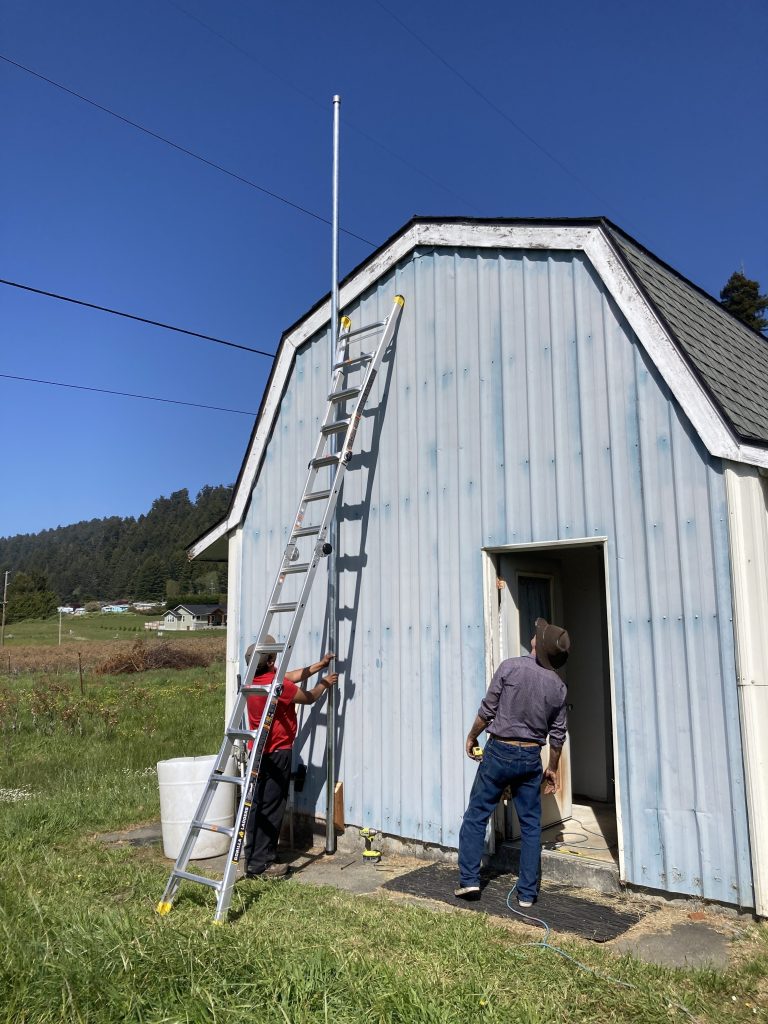
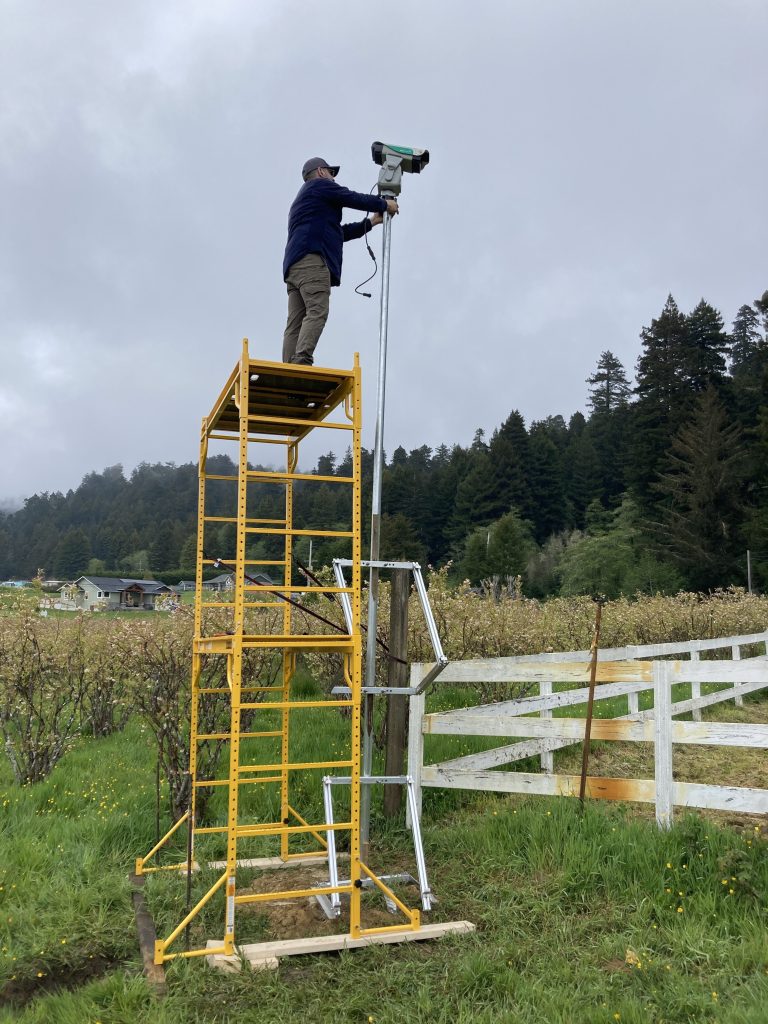
We programmed both lasers to “scrub” the fields in a random pattern from dawn until dusk. The addition of a bright green light swirling around the field that already has dozens of waving strands of reflective bird scare tape gives the field a “disco” vibe. Hopefully birds don’t like discos.
A huge thank you to Chris Howard and the Alexandre family for all of their help and generosity! Fingers crossed that the lasers will be a successful replacement for the propane cannon.
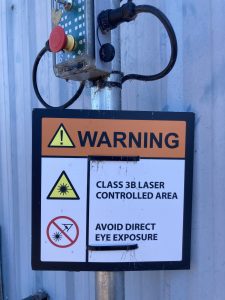
For safety, I’m required to post a sign at the entrance of the farm to notify visitors that the lasers are running. The language is far more alarming than I think it needs to be, but a sign that warns “CLASS 3B LASER CONTROLLED AREA” has turned out to be quite a conversation starter.
If you come to the farm, just know that it is completely safe to look at the light that the laser casts on objects and it is harmless if the laser passes over you. Just don’t look directly at the source of the laser.


You must be logged in to post a comment.